


Behind the Camera: What Happens When a Community Tells Its Own Story
Most documentaries are made by outsiders. Someone arrives with a camera, captures what they see, and leaves with the footage. The story gets told, but usually through someone else's lens, for someone else's audience.
Community-centered filmmaking works differently. It starts with the people who live the story.
At Thriving Communities, filmmaking isn't content production. It's a relationship. Every project begins with the same question: whose story is this, and how do they want it told? When we filmed Land and Heart in Iowa, it was the culmination of a process that unfolded over time before the cameras rolled.
That investment changes what ends up on screen. Instead of a story about a community, you get a story from one.
Research on community-centered storytelling consistently shows that when people share their own narratives, the effect goes beyond documentation. A study on participatory storytelling in community development found that neighbors who rarely spoke to each other walked home together after sharing stories. Meetings that started with complaints ended with eagerness to organize (CDA Collaborative Learning, 2024). Stories didn't just record what was happening — they changed what people believed was possible.
Documentary film has a particular power in this space. The Center for Media and Social Impact describes it as "contagious empathy" — the experience of connecting so deeply with someone else's reality that you're moved to act (CMSI, Hot Docs Impact Report, 2014). When that story is local — when the person on screen lives down the road — the effect is even stronger. It's not abstract. It's your neighbor.
Solutions journalism, which focuses on how communities respond to challenges rather than just documenting the problems, is emerging as a key approach for local filmmakers. When audiences see people like them building real solutions, the question shifts from "what's wrong?" to "what can we do?" (One World Media, 2024).
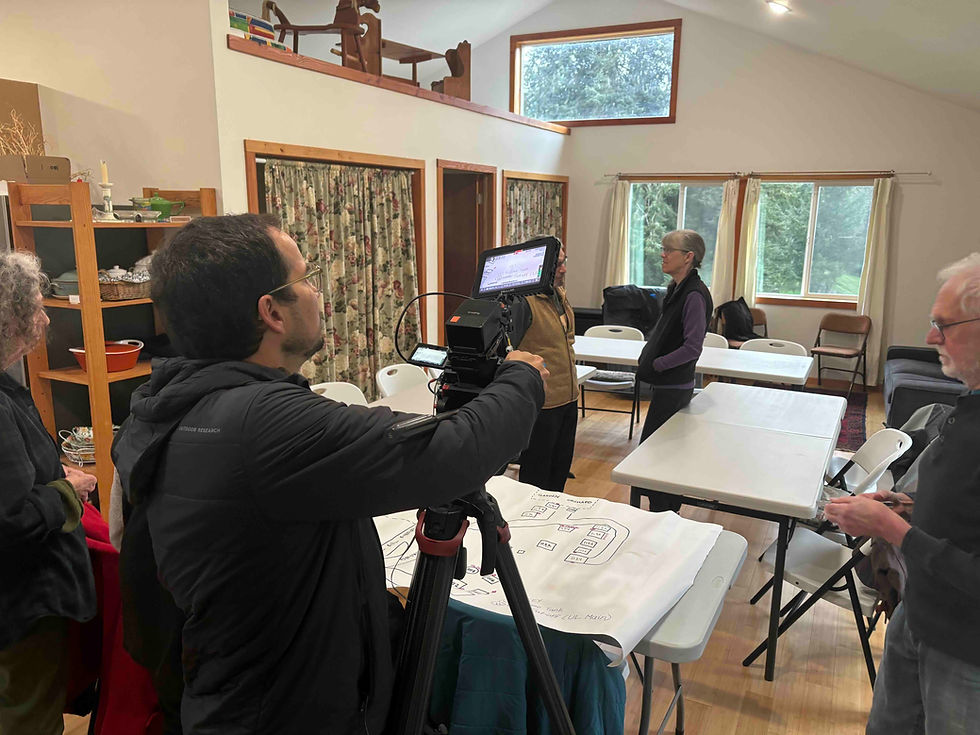
This is why our next film, South Whidbey Prepares, matters. It's not about disaster preparedness in the abstract. It's about one island community figuring out how to take care of each other — told by the people doing the work. The camera is a tool, but the story belongs to the community.
Your community has stories worth telling. Not because they're dramatic or cinematic, but because they're real. The neighbor who organized the supply drive. The group that figured out how to feed people when funding disappeared. The person who showed up and kept showing up. Those stories build identity. They create belonging. They remind people what they're capable of when they act together.
Sometimes the most regenerative thing a community can do is see itself clearly.
Sources:
"Can Storytelling Fuel Community-led Development?" CDA Collaborative Learning, 2024
"Documentary Impact: Social Change Through Storytelling," Hot Docs, 2014
"When Solutions Journalism Meets Documentary Filmmaking," One World Media, 2024

